

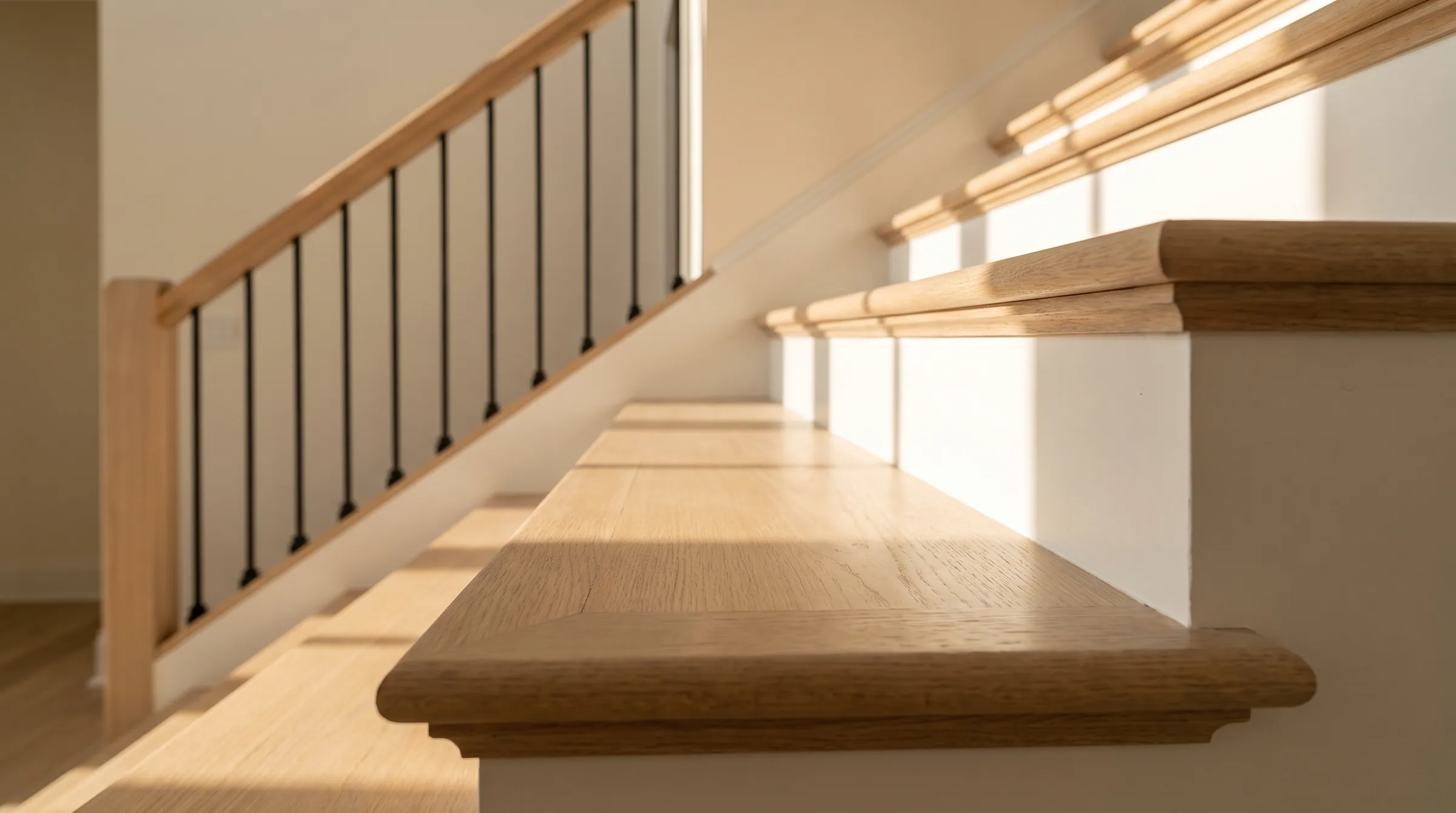
How much can risers and treads vary within one flight?
Within any flight of stairs the greatest riser height may not exceed the smallest by more than 3/8″, the greatest tread depth may not exceed the smallest by more than 3/8″, and the greatest nosing projection may not exceed the smallest by more than 3/8″. The rule is the same in the IRC and the IBC, and the accessibility standards simply say uniform. It is the rule that decides whether a thick tread can go over an existing stair.
Reflects 2021 IRC · 2021 IBC · ICC A117.1 · 2010 ADA · 2012 TAS. Adoption is local and amended — confirm the edition your authority having jurisdiction has adopted.
- Riser variation
- 3/8″ max in a flight
- Tread variation
- 3/8″ max in a flight
- Nosing variation
- 3/8″ max in a stairway
- Applies
- IRC · IBC · A117.1
The 3/8-Inch Rule
Within any flight of stairs the greatest riser height may not exceed the smallest by more than 3/8″, the greatest tread depth may not exceed the smallest by more than 3/8″, and the greatest nosing projection may not exceed the smallest by more than 3/8″. The rule is the same in the IRC and the IBC, and the accessibility standards simply say uniform. It is the rule that decides whether a thick tread can go over an existing stair.
Residential, commercial and accessible
| Item | Residential · IRC | Commercial · IBC | Accessible · A117.1 / ADA / TAS |
|---|---|---|---|
| Riser height | 3/8″ between largest and smallest | 3/8″ | Uniform |
| Tread depth | 3/8″ | 3/8″ | Uniform |
| Nosing projection | 3/8″ | Uniform size, including at the top of the flight | — |
| Scope | Within a flight | Within a flight | Within a flight |
Why 3/8 of an inch
People climb a stair on the rhythm of the first two steps. A riser that is ½″ taller than the ones before it catches the toe on the way up; one that is ½″ shorter drops the foot on the way down. 3/8″ is the variation research found people absorb without a misstep. The limit is between the largest and smallest in the flight, not between neighbours, so two errors of 1/4″ in opposite directions fail.
The retro-fit problem
Lay a 1″ tread over every step of an existing stair and every riser stays the same — except the bottom one, which gains 1″, and the top one, which loses 1″ where the new tread meets the old floor. Both are far outside 3/8″. The fix is either a tread thin enough that the difference stays within the rule after the finished floor is accounted for, or cutting the stringers down and re-setting the bottom, or re-framing.
The 8071 and 8073 retro-fit treads exist for this: a 5/8″ body that, with adhesive, matches the thickness of the flooring being laid at the top of the flight so the top riser is unchanged, while the bottom riser gains only what the new floor at the bottom also gains.
Nosings count too
The nosing at the top of the flight — the floor edge or landing tread — is part of the same uniformity check. A 1¼″ bullnose tread on every step and a square-edged floor at the top with no nosing is a 1¼″ variation. The landing tread or stair nosing at the top has to match the treads.
The sections, as the tables carry them
These rows are the same rows the full residential and commercial tables show, filtered to this rule. Change one there and it changes here.
Stair geometry
| Item | Requirement | 2021 IRC | UWP note |
|---|---|---|---|
| Riser uniformity | No more than 3/8″ between the largest and smallest riser in a flight. | R311.7.5.1 | This is the rule that governs retro-fit treads — see the Retro-Fit Tread Guide. |
| Tread uniformity | No more than 3/8″ between the deepest and shallowest tread in a flight. | R311.7.5.2 | |
| Nosing projection | ¾″ minimum to 1¼″ maximum where the tread depth is under 11″. Not required at 11″ or deeper. Variation ≤ 3/8″. | R311.7.5.3 | Stocked tread nosings run 1″–1¼″; square-edge profiles rely on tread depth ≥ 11″. |
- Riser uniformityR311.7.5.1
No more than 3/8″ between the largest and smallest riser in a flight.
This is the rule that governs retro-fit treads — see the Retro-Fit Tread Guide.
- Tread uniformityR311.7.5.2
No more than 3/8″ between the deepest and shallowest tread in a flight.
- Nosing projectionR311.7.5.3
¾″ minimum to 1¼″ maximum where the tread depth is under 11″. Not required at 11″ or deeper. Variation ≤ 3/8″.
Stocked tread nosings run 1″–1¼″; square-edge profiles rely on tread depth ≥ 11″.
Stair geometry
| Item | Requirement | 2021 IBC | UWP note |
|---|---|---|---|
| Uniformity | No more than 3/8″ between the largest and smallest riser, or tread, in a flight. | 1011.5.4 | |
| Nosing projection | 1¼″ maximum beyond the tread below. Uniform size throughout, including the floor edge at the top of the flight. | 1011.5.5.1 · 1011.5.5.2 | A landing tread or nosing at the top of the flight must match the tread nosing — spec both from the same profile. |
- Uniformity1011.5.4
No more than 3/8″ between the largest and smallest riser, or tread, in a flight.
- Nosing projection1011.5.5.1 · 1011.5.5.2
1¼″ maximum beyond the tread below. Uniform size throughout, including the floor edge at the top of the flight.
A landing tread or nosing at the top of the flight must match the tread nosing — spec both from the same profile.
How the rule is met with the part
Every retro-fit quote is checked against the 3/8″ rule at the top and bottom riser before it is cut. Send the existing riser heights, the tread thickness coming off and the floor going down at the top, and the answer is whether 8071 / 8073 holds the flight within the rule or whether the stringers need work. The 8091 landing tread and the stair nosing profiles carry the same 1¼″ projection as the 8070 tread so the top of the flight matches.
What fails inspection
- 01
Checking riser heights against the 7¾″ maximum and stopping. A flight of 7″ risers with one 7½″ riser is under the maximum everywhere and fails uniformity.
- 02
Comparing adjacent risers only. The rule is largest against smallest anywhere in the flight.
- 03
Leaving the top nosing square when every tread below has a 1¼″ bullnose.
Questions on this rule
- Does the 3/8″ rule apply across a landing?
- No. It applies within a flight. The flight above a landing may have a different riser height from the flight below, though good practice keeps them the same.
- Can I put 1″ treads over my existing stairs?
- Only if the finished floor at the top of the flight is also being raised by about the same amount and the bottom riser can be corrected. The Retro-Fit Tread Guide walks through the arithmetic; the plain answer is usually the 5/8″ retro-fit tread.
- Is 3/8″ measured on the framing or the finished stair?
- On the finished stair. The inspector measures what a foot meets.
Send the section. We answer with the part that meets it.
Riser, tread, nosing radius, rail perimeter, extension length — send the stair section and the adopted code year and the shop drawing comes back with each one called out.
Questions that come up on these details
Can you retrofit thick stair treads over existing stairs?
Thick stair treads (1¾″ to 3½″) aren’t retrofit material — adding that much thickness changes the rise of the top step, puts the stair out of code, and creates a visible step where the new tread meets the upstairs floor. For the thick-tread look on existing stairs, the honest answer is a full tear-down to the stringers and a rebuild from the framing up.
Read the answer →8070 vs. 8071 — which stair tread fits my existing staircase?
The 8070 is a full 1″ tread for new builds or full demos. The 8071 is a 5/8″ retro-fit overlay built to drop over carpeted stairs without demolition. The key reason: when you pull the carpet, the wood skirt board next to the staircase is roughly 11/16″ thick. The 8071 lands flush against it. The 8070 sits about 1/4″ proud and looks unfinished.
Read the answer →