

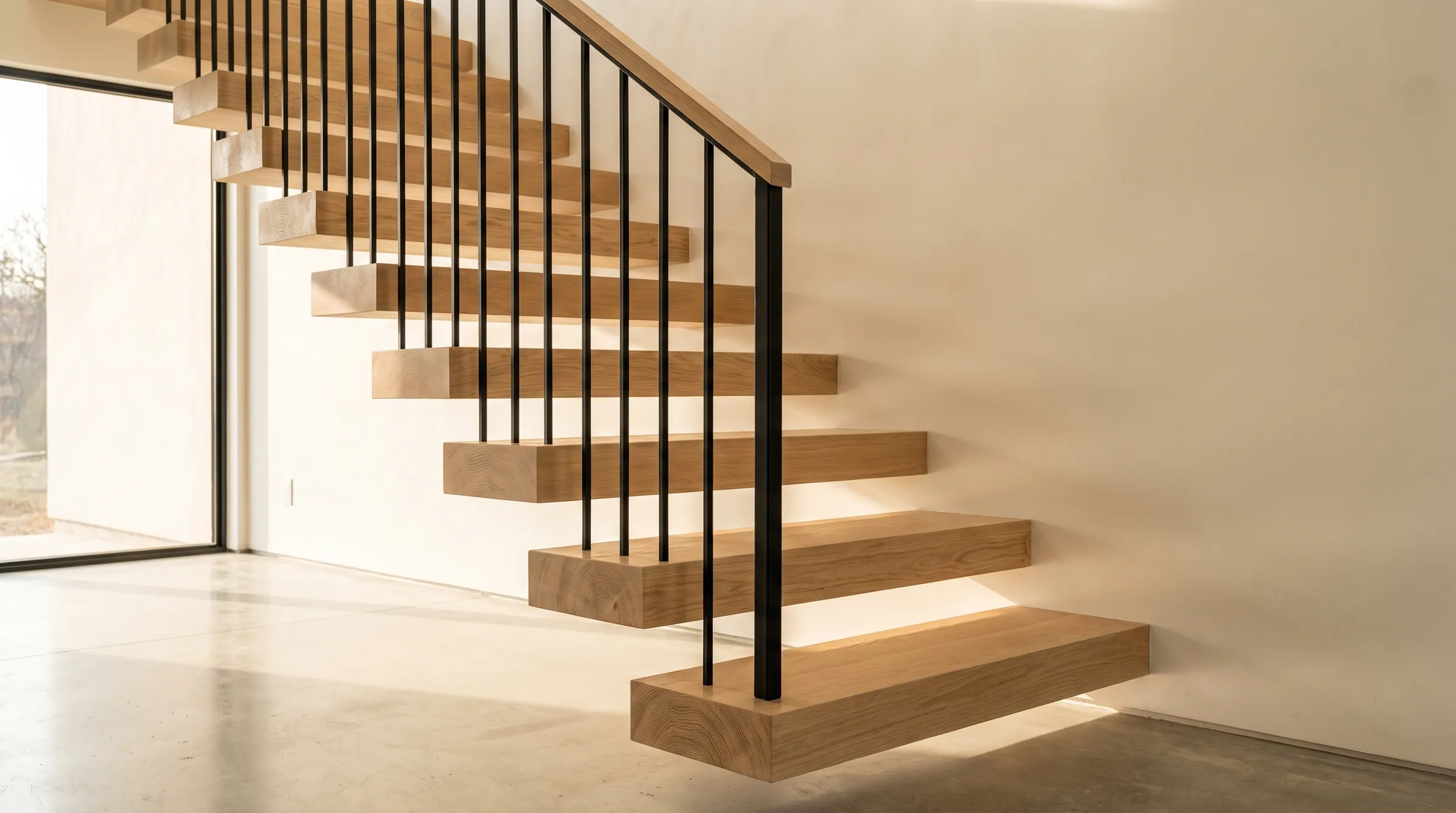
What load does a stair tread have to carry?
A residential stair is designed for a uniform live load of 40 pounds per square foot; a commercial stair for 100 psf. In both, each tread must also carry a 300-pound concentrated load on an area of 4 square inches — a heel — wherever it produces the greater stress. On a conventional stair the stringers take the load and a 1″ tread bearing on three stringers is far stronger than it needs to be. The rule bites on open-riser and cantilevered stairs, where the tread spans free between supports and its thickness is the structure.
Reflects 2021 IRC · 2021 IBC · ICC A117.1 · 2010 ADA · 2012 TAS. Adoption is local and amended — confirm the edition your authority having jurisdiction has adopted.
- Residential
- 40 psf
- Commercial
- 100 psf
- Any tread
- 300 lb on 4 sq in
- Governs
- Open-riser and cantilevered treads
Stair Live Loads
A residential stair is designed for a uniform live load of 40 pounds per square foot; a commercial stair for 100 psf. In both, each tread must also carry a 300-pound concentrated load on an area of 4 square inches — a heel — wherever it produces the greater stress. On a conventional stair the stringers take the load and a 1″ tread bearing on three stringers is far stronger than it needs to be. The rule bites on open-riser and cantilevered stairs, where the tread spans free between supports and its thickness is the structure.
Residential, commercial and accessible
| Item | Residential · IRC | Commercial · IBC | Accessible · A117.1 / ADA / TAS |
|---|---|---|---|
| Uniform live load | 40 psf | 100 psf (40 psf in one- and two-family dwellings) | — |
| Concentrated load on a tread | 300 lb on 4 sq in | 300 lb on 4 sq in | — |
| Applied | Whichever produces the greater stress | Whichever produces the greater stress | — |
| Deflection | L/360 for floor members | L/360 | — |
Where the load goes on a conventional stair
On a closed- or cut-stringer stair the tread bears continuously along its back edge and at each stringer, so the span is the stringer spacing — 12″ to 18″ — and a 1″ hardwood tread on that span is loaded to a small fraction of its capacity. Tread thickness on a conventional stair is chosen for the nosing profile, the riser detail and the look, not for strength.
Open-riser, mono-stringer and cantilevered treads
Take the risers away and the tread spans between its supports with nothing under it. A 36″ tread on a centre mono-stringer is a 16″ cantilever each side; a tread on two outside stringers spans 36″ clear; a tread let into a wall spans its whole length as a cantilever. Then the 300 lb at the nosing corner is the case that governs, and the tread thickness — and species, and grain direction — is the design. Thick treads for these stairs are sized by the fabricator’s or the architect’s engineer, with the tread depth, thickness and support points on the drawing.
Deflection, not just strength
A tread that carries the load but springs under it feels unsafe and will open its joints. Floor members are limited to L/360 under live load; a 36″ clear tread span allows 0.1″. That is the number an EGU tread is checked against, and it is why a face-grain slab tread on a wide span is glued up with the grain running the length of the span.
The sections, as the tables carry them
These rows are the same rows the full residential and commercial tables show, filtered to this rule. Change one there and it changes here.
Loads
| Item | Requirement | 2021 IRC | UWP note |
|---|---|---|---|
| Stair live load | 40 psf uniformly distributed. | Table R301.5 | |
| Tread concentrated load | 300 lb on an area of 4 sq in, at any point on any tread, where it produces greater stress than the uniform load. | Table R301.5, note | Governs open-riser and cantilevered treads, where the tread spans free. Conventional stringer stairs are prescriptive. |
- Stair live loadTable R301.5
40 psf uniformly distributed.
- Tread concentrated loadTable R301.5, note
300 lb on an area of 4 sq in, at any point on any tread, where it produces greater stress than the uniform load.
Governs open-riser and cantilevered treads, where the tread spans free. Conventional stringer stairs are prescriptive.
Loads
| Item | Requirement | 2021 IBC | UWP note |
|---|---|---|---|
| Stair live load | 100 psf uniformly distributed; 40 psf in one- and two-family dwellings. | Table 1607.1 | |
| Tread concentrated load | 300 lb on an area of 4 sq in, where it produces greater stress than the uniform load. | Table 1607.1, note |
- Stair live loadTable 1607.1
100 psf uniformly distributed; 40 psf in one- and two-family dwellings.
- Tread concentrated loadTable 1607.1, note
300 lb on an area of 4 sq in, where it produces greater stress than the uniform load.
How the rule is met with the part
UWP builds thick treads two ways. EGU treads are edge-glued from 5/4 staves set on edge, so the span direction runs along the staves and the section is deep and stable; they are the standard for open-riser and mono-stringer stairs and are quoted at 2″, 2½″, 3″ and thicker. Face-grain treads are laid up for appearance and are used where the span is short or the support is continuous. Send the support condition with the drawing — stringers, mono-stringer, or wall-hung — and the tread is quoted to it.
What fails inspection
- 01
A 1¾″ face-grain tread on a mono-stringer with 16″ cantilevers each side and no engineering.
- 02
Treating the 40 psf as the only load and ignoring the 300 lb at the nosing corner.
- 03
Thick treads specified for looks on a cantilevered stair with the grain running across the span.
Questions on this rule
- How thick does an open-riser tread need to be?
- For the 4″ sphere rule, about riser height minus 4″. For strength, it depends on the span and the support; 2″–3″ EGU covers most stringer-supported open-riser stairs, and cantilevers are engineered case by case.
- Is the 300 lb load applied to every tread?
- Yes — to each tread individually, on 4 sq in, at the worst location, which is the nosing corner on a cantilever.
- Do stairs in a house need to be engineered?
- A conventional stringer stair is prescriptive under the IRC and needs no calculation. An open-riser or cantilevered stair is outside the prescriptive detail and the AHJ can ask for an engineer’s stamp on it.
Send the section. We answer with the part that meets it.
Riser, tread, nosing radius, rail perimeter, extension length — send the stair section and the adopted code year and the shop drawing comes back with each one called out.
Questions that come up on these details
What’s the difference between a 1″ and a 1¾″ stair tread?
A 1″ stair tread is a retrofit cap that drops over an existing staircase — fast, affordable, and the right choice for most closed-stringer residential stairs. A 1¾″ thick tread is a structural-looking slab built for open, floating, or modern stairs where the tread itself is part of the architecture. Thickness changes the price, the install, and the entire look of the stair — not just the dimension.
Read the answer →EGU vs. face-grain thick treads — which one for my project?
EGU (edge grain up — staves turned on edge, glued like a butcher block) and face-grain (boards glued for the depth, laminated for the thickness) are UWP’s two custom thick-tread programs. EGU shows tight, linear butcher-block grain and offers the best dimensional stability for Houston humidity. Face-grain looks like a thicker version of a standard plank tread. Both are milled with a square or 1/8″ eased edge only and quoted by hand. Pick EGU for a modern statement; face-grain for traditional substance.
Read the answer →Engineered vs. solid hardwood stair treads — what’s the difference?
Solid hardwood stair treads are a single piece of wood, top to bottom — 1″ thick, refinishable for decades. Engineered "stair treads" are a thin hardwood veneer (2–6 mm) over a plywood or composite core, designed to match engineered floor planks. Solid lasts generations; engineered lasts 15 to 25 years. UWP mills only solid — the cost difference doesn’t justify the lifespan gap.
Read the answer →