

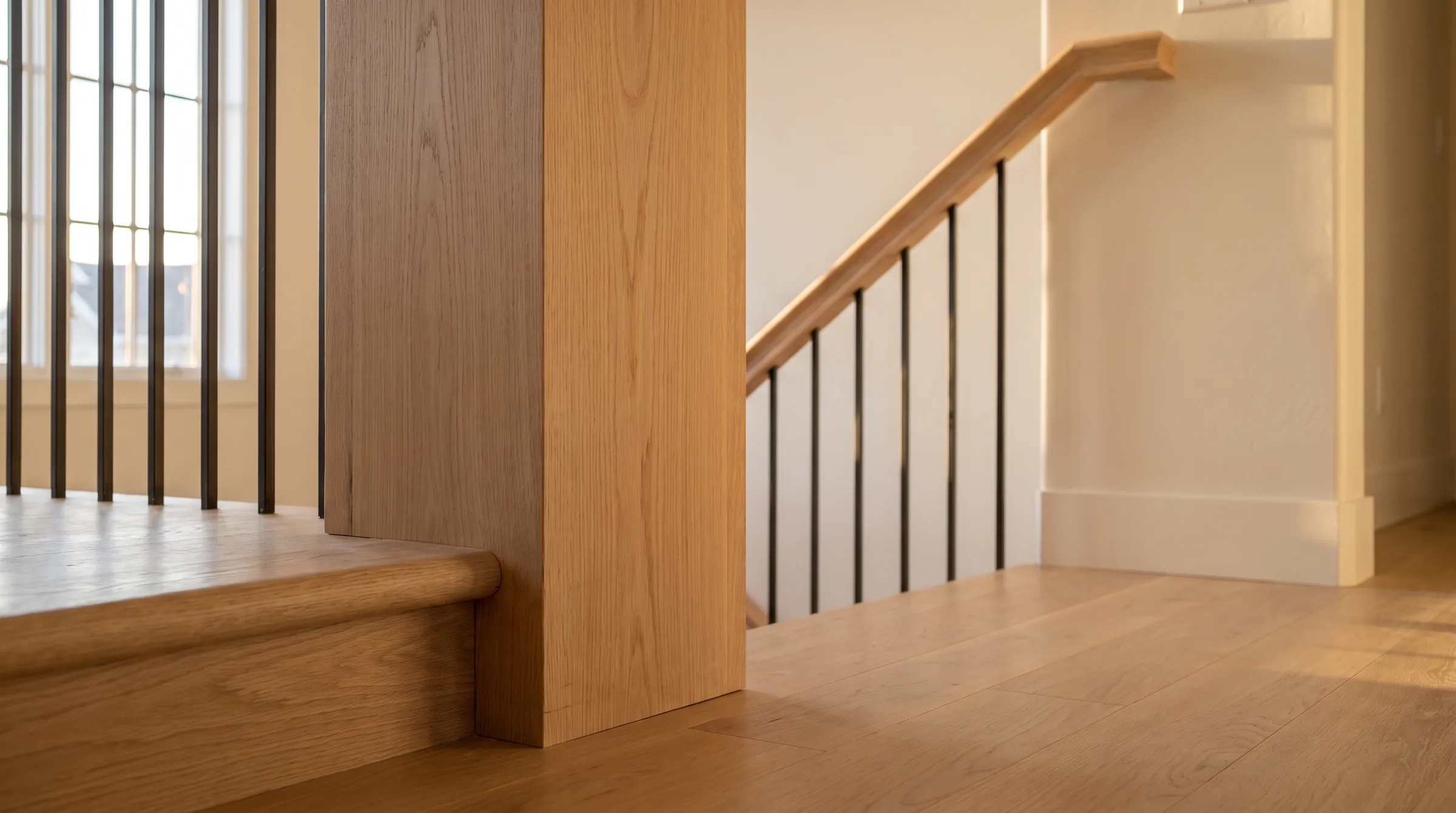
How strong does a handrail or guard have to be?
Every handrail and guard must resist a 200-pound concentrated load applied in any direction at any point along its top. Commercially, the IBC adds a uniform load of 50 pounds per linear foot along the top, applied in any direction, not at the same time as the 200 lb. Balusters and other in-fill must resist a horizontal load of 50 lb spread over one square foot. The loads are on the system as installed, and in a wood system the item that decides whether it passes is almost always the newel post and how it is fastened to the structure.
Reflects 2021 IRC · 2021 IBC · ICC A117.1 · 2010 ADA · 2012 TAS. Adoption is local and amended — confirm the edition your authority having jurisdiction has adopted.
- Top of rail or guard
- 200 lb, any direction, any point
- Commercial, uniform
- 50 plf along the top
- In-fill
- 50 lb on 1 sq ft
- Applies
- IRC R301.5 · IBC 1607.9
Handrail and Guard Loads
Every handrail and guard must resist a 200-pound concentrated load applied in any direction at any point along its top. Commercially, the IBC adds a uniform load of 50 pounds per linear foot along the top, applied in any direction, not at the same time as the 200 lb. Balusters and other in-fill must resist a horizontal load of 50 lb spread over one square foot. The loads are on the system as installed, and in a wood system the item that decides whether it passes is almost always the newel post and how it is fastened to the structure.
Residential, commercial and accessible
| Item | Residential · IRC | Commercial · IBC | Accessible · A117.1 / ADA / TAS |
|---|---|---|---|
| Concentrated load on the top | 200 lb, any direction, any point | 200 lb, any direction, any point | — |
| Uniform load on the top | Not required | 50 plf in any direction (not concurrent with the 200 lb) | — |
| In-fill (balusters, panels) | 50 lb horizontal on 1 sq ft | 50 lb horizontal on 12″ × 12″ | — |
| Handrail fittings | — | Rail shall not rotate within fittings | Shall not rotate within fittings |
Where it is measured
What 200 pounds at the top of a post means
200 lb pushed sideways at the top of a 36″ newel is 600 foot-pounds of moment at its base; at 42″ it is 700. A newel that is toe-screwed to the floor cannot take it. A newel that runs through the floor and is bolted to a joist, or that is lagged through a solid tread into a blocked stringer, or that uses a rated mounting bolt into blocking, can. The load is checked by the inspector with a hand and a shove; the number is what the engineer checks on a commercial submittal.
The rail and the balusters
A hardwood rail spanning between newels at 6′–8′ carries the 200 lb comfortably in bending; the rail is not the weak point. Balusters take the in-fill load — 50 lb on a square foot, which is about one baluster’s share — and pass by being set into the tread and the rail rather than surface-fixed. The joints between rail and newel, and between rail fittings, are where a wood system moves: a rail bolt or a rated joint fastener at each newel, and glued and pinned fittings, are what stop the rail rotating and racking under the load.
Commercial: the 50 plf and the engineer
The uniform 50 plf is applied along the whole length of the guard, in any direction, and is the load that sizes posts on long balcony runs. It is not applied together with the 200 lb; the guard is checked for each separately. On IBC projects the guard is usually a delegated-design item: the fabricator’s engineer stamps the calculation for the posts and their anchorage, and the wood components are specified to that design. The one- and two-family exception drops the 50 plf, which is why the IRC table has only the 200 lb.
The sections, as the tables carry them
These rows are the same rows the full residential and commercial tables show, filtered to this rule. Change one there and it changes here.
Loads
| Item | Requirement | 2021 IRC | UWP note |
|---|---|---|---|
| Handrail and guard load | 200 lb concentrated, applied in any direction at any point along the top of the handrail or guard. | Table R301.5 | 200 lb at the top of a 36″ post is 600 ft-lb at the base. Newels are through-bolted to framing or set with a rated mounting bolt into blocking. |
| Guard in-fill load | 50 lb horizontal on a 1 sq ft area, including openings and the space between rails, not concurrent with the top-rail load. | Table R301.5 | Balusters set into the tread and the rail, not surface-fixed. |
- Handrail and guard loadTable R301.5
200 lb concentrated, applied in any direction at any point along the top of the handrail or guard.
200 lb at the top of a 36″ post is 600 ft-lb at the base. Newels are through-bolted to framing or set with a rated mounting bolt into blocking.
- Guard in-fill loadTable R301.5
50 lb horizontal on a 1 sq ft area, including openings and the space between rails, not concurrent with the top-rail load.
Balusters set into the tread and the rail, not surface-fixed.
Loads
| Item | Requirement | 2021 IBC | UWP note |
|---|---|---|---|
| Handrail and guard — uniform | 50 plf applied in any direction along the handrail or top rail. Not required for one- and two-family dwellings. | 1607.9.1 | Sizes the posts on long balcony runs. Not applied concurrently with the 200 lb. |
| Handrail and guard — concentrated | 200 lb applied in any direction at any point along the handrail or top rail. | 1607.9.1.1 | |
| In-fill | Balusters, panels and other in-fill: 50 lb horizontal on an area not exceeding 12″ × 12″, including openings and the space between rails, not concurrent with the top-rail loads. | 1607.9.1.2 |
- Handrail and guard — uniform1607.9.1
50 plf applied in any direction along the handrail or top rail. Not required for one- and two-family dwellings.
Sizes the posts on long balcony runs. Not applied concurrently with the 200 lb.
- Handrail and guard — concentrated1607.9.1.1
200 lb applied in any direction at any point along the handrail or top rail.
- In-fill1607.9.1.2
Balusters, panels and other in-fill: 50 lb horizontal on an area not exceeding 12″ × 12″, including openings and the space between rails, not concurrent with the top-rail loads.
How the rule is met with the part
UWP newels are solid or built-up box posts sized to be fastened through the floor or tread to framing, and the hardware catalogue carries the newel mounting bolts and rail joint fasteners. The Handrail & Newel Installation Guide details three attachments: through-bolt to the joist, lag to blocking under the tread, and the mounting-bolt method into a blocked landing. On commercial work the newel attachment is drawn on the submittal so the engineer can check it against 1607.9.
What fails inspection
- 01
A starting newel fixed with construction adhesive and a toe-screw into the tread. The first inspector to lean on it will find it.
- 02
A landing newel notched over a bullnose with nothing behind it.
- 03
A long balcony guard on a commercial project with no engineering for the posts.
Questions on this rule
- Who checks the 200-pound load?
- On a house, the inspector by hand at final. On a commercial project, the engineer of record or the fabricator’s delegated engineer on paper, and the inspector by hand.
- Does a wood handrail need to be tested?
- No test is required by the codes; the loads are design loads. Manufacturers of proprietary systems test them; a site-built hardwood rail relies on sound joinery and newel attachment.
- Is the 50 plf required on a house?
- No. The IRC requires the 200 lb concentrated load and the 50 lb in-fill load. The IBC’s 50 plf exempts one- and two-family dwellings.
Send the section. We answer with the part that meets it.
Riser, tread, nosing radius, rail perimeter, extension length — send the stair section and the adopted code year and the shop drawing comes back with each one called out.
Questions that come up on these details
How do I choose a stair newel post?
A newel post is the structural anchor at the top, bottom, and turns of a stair railing. The four main families are box newel (large rectangular, traditional), turned newel (classical with profile turning), modern square (clean tapered or straight), and craftsman (substantial square with shaker detail). Size to the stair scale (4 to 8 inches), match the baluster style, and use the same wood species as the handrail.
Read the answer →Iron vs. wood balusters — which one for my staircase?
Wood balusters read as traditional and warm; iron balusters read as transitional, modern, or industrial. Wood is easier to install, refinishable, and matches stained handrails. Iron is more durable, allows thinner profiles for a more open stair, and pairs well with mixed-material designs. Most Houston homes built since 2010 use iron; older traditional homes use wood. Mix them only if the design language supports it.
Read the answer →