

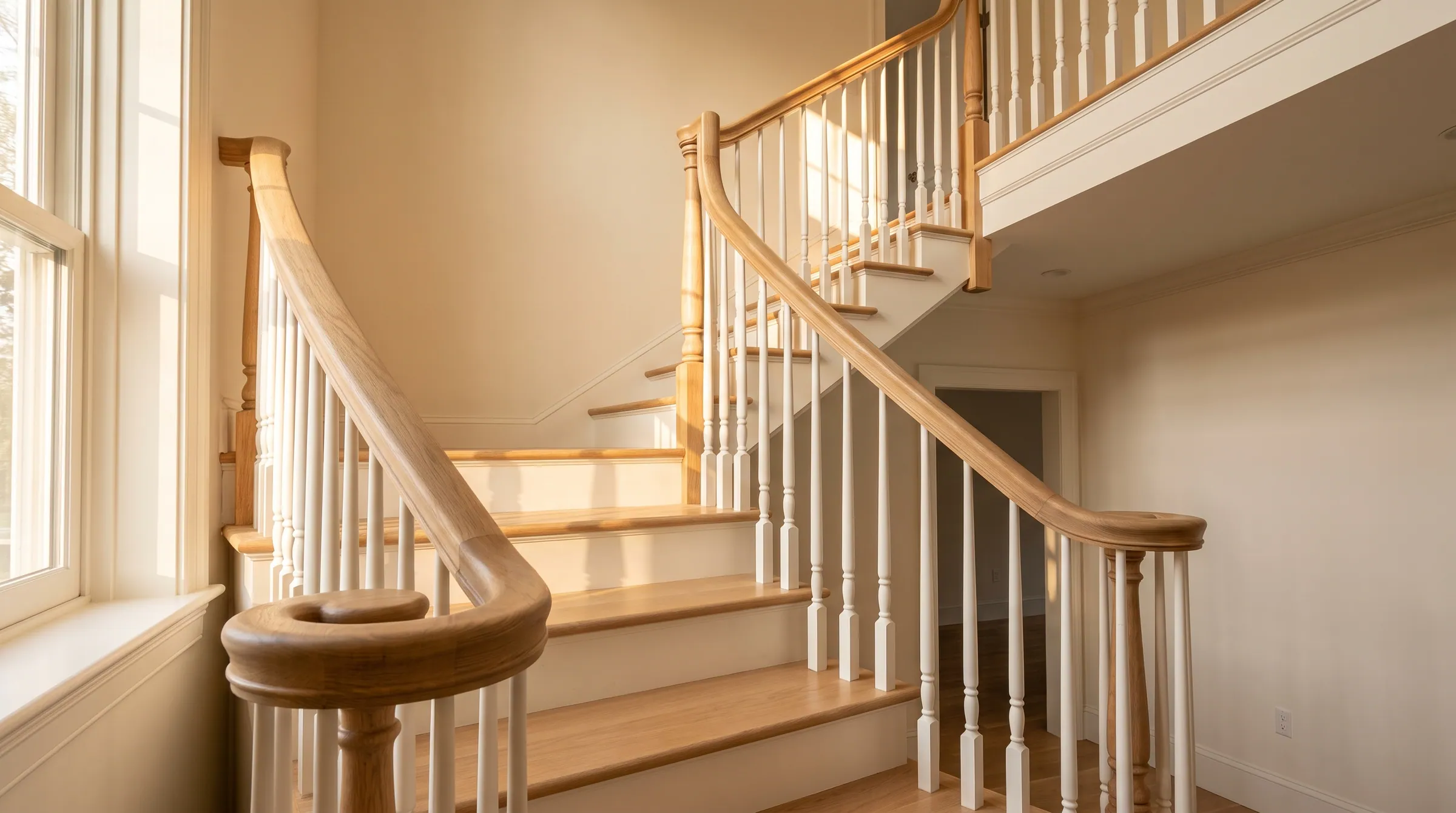
Does a handrail have to be continuous, and how must it end?
A handrail must be continuous for the full length of the flight, from a point directly above the top riser to a point directly above the bottom riser, and its ends must return to the wall or end in a newel post or a safety terminal so a sleeve cannot catch on them. In a house the rail may be interrupted by a newel at a turn and may start with a volute, turnout or starting easing over the lowest tread. On a commercial stair the gripping surface may not be interrupted by newels or anything else, which is what over-the-post fittings are for.
Reflects 2021 IRC · 2021 IBC · ICC A117.1 · 2010 ADA · 2012 TAS. Adoption is local and amended — confirm the edition your authority having jurisdiction has adopted.
- Length
- Top riser to bottom riser
- Ends
- Returned, or a newel or terminal
- Residential
- Newel may interrupt at a turn
- Commercial
- No interruptions
Continuity and Returns
A handrail must be continuous for the full length of the flight, from a point directly above the top riser to a point directly above the bottom riser, and its ends must return to the wall or end in a newel post or a safety terminal so a sleeve cannot catch on them. In a house the rail may be interrupted by a newel at a turn and may start with a volute, turnout or starting easing over the lowest tread. On a commercial stair the gripping surface may not be interrupted by newels or anything else, which is what over-the-post fittings are for.
Residential, commercial and accessible
| Item | Residential · IRC | Commercial · IBC | Accessible · A117.1 / ADA / TAS |
|---|---|---|---|
| Continuous | Full length of the flight | Full length, uninterrupted gripping surface | Full length of each flight |
| Newel interruption | Permitted at a turn | Only inside a dwelling unit | Not permitted |
| Bottom termination | Volute, turnout or starting easing over the lowest tread; or newel or safety terminal | Return to wall, guard or floor, or continue to the next flight | Extension, then return or continue |
| Inside rail at a switchback | — | Continuous between flights where it does not extend | Continuous between flights |
Where it is measured
Why ends are returned
A rail that stops in the air catches a coat sleeve or a bag strap and the person keeps moving. Returning the end into the wall, ending it in a newel, or fitting a safety terminal — a cap, a return or a rosette — removes the hook. The rule applies at both ends and to a wall rail as much as a guard rail.
Post-to-post: the residential answer
A post-to-post system runs the rail between newels. The rail is continuous along the flight, terminates in the starting newel at the bottom and the landing newel at the top, and the IRC exception lets a newel at a landing or a turn interrupt it. That is the system most houses have and it meets R311.7.8.4 as written.
Over-the-post: continuous through the fittings
Where the rail must not be interrupted — every IBC stair outside a dwelling unit, and every accessible stair — the rail passes over the newels. Pin-top newels stop under the rail, and fittings carry it through each change of direction: a starting easing or volute at the bottom, a gooseneck up to the landing height, level quarter-turns around the landing, and a return or a wall return where it ends. The rail is one gripping surface from the top of the flight to the bottom, which is what the IBC and A117.1 mean by continuous.
The sections, as the tables carry them
These rows are the same rows the full residential and commercial tables show, filtered to this rule. Change one there and it changes here.
Handrails
| Item | Requirement | 2021 IRC | UWP note |
|---|---|---|---|
| Continuity | Continuous the full length of the flight, from a point above the top riser to a point above the lowest riser. Ends return to a wall or terminate at a newel post or safety terminal. | R311.7.8.4 | Volutes, turnouts and starting easings are the code-recognized way to terminate at the bottom. |
- ContinuityR311.7.8.4
Continuous the full length of the flight, from a point above the top riser to a point above the lowest riser. Ends return to a wall or terminate at a newel post or safety terminal.
Volutes, turnouts and starting easings are the code-recognized way to terminate at the bottom.
Handrails
| Item | Requirement | 2021 IBC | UWP note |
|---|---|---|---|
| Continuity | Continuous without interruption by newel posts or other obstructions. | 1014.4 | Exception: a newel at a turn or landing may interrupt the rail in R-3 and dwelling units. Over-the-post fittings keep a commercial rail continuous. |
| Extensions — top | 12″ horizontal beyond the top riser, returned to a wall, guard or the walking surface. | 1014.6 | |
| Extensions — bottom | One tread depth sloped beyond the bottom riser, then returned or continued to the next flight. | 1014.6 |
- Continuity1014.4
Continuous without interruption by newel posts or other obstructions.
Exception: a newel at a turn or landing may interrupt the rail in R-3 and dwelling units. Over-the-post fittings keep a commercial rail continuous.
- Extensions — top1014.6
12″ horizontal beyond the top riser, returned to a wall, guard or the walking surface.
- Extensions — bottom1014.6
One tread depth sloped beyond the bottom riser, then returned or continued to the next flight.
How the rule is met with the part
UWP carries both systems in the 6010 / 6210 / 6710 profiles: box and turned newels for post-to-post, pin-top newels and the full fitting family — volutes, turnouts, starting easings, goosenecks, quarter-turns, tandem caps and returns — for over-the-post. The Over-the-Post Installation Guide sets out the fitting sequence for a continuous rail through a landing.
What fails inspection
- 01
A wall rail cut square at the top and bottom with the ends open.
- 02
A post-to-post rail on a commercial stair, with the landing newel breaking the grip.
- 03
A rail that starts over the second riser because the starting newel was set back from the first.
Questions on this rule
- Can a handrail stop at a newel post?
- In a house, yes — a newel is a code-recognised termination, and a newel at a turn may interrupt the rail. On commercial and accessible stairs the rail must continue past or over the newel.
- Is a volute a code-compliant start?
- Yes. The IRC names the volute, turnout and starting easing as permitted over the lowest tread, and they are also allowed to rise above the 38″ height limit there.
- What is a safety terminal?
- Any end treatment that leaves no hook: a wall return, a rosette, a cap or a rail that turns down into the post. The code names it so that a rail need not literally end in a newel.
Send the section. We answer with the part that meets it.
Riser, tread, nosing radius, rail perimeter, extension length — send the stair section and the adopted code year and the shop drawing comes back with each one called out.
Questions that come up on these details
How do I choose a stair newel post?
A newel post is the structural anchor at the top, bottom, and turns of a stair railing. The four main families are box newel (large rectangular, traditional), turned newel (classical with profile turning), modern square (clean tapered or straight), and craftsman (substantial square with shaker detail). Size to the stair scale (4 to 8 inches), match the baluster style, and use the same wood species as the handrail.
Read the answer →What height should my stair handrail be?
The IRC requires stair handrail height between 34 and 38 inches above the nosings — measured straight up from the front edge of each tread. Most installers land at 36 inches as a comfort default. Taller homes or households with taller users can go to 38; shorter occupants and accessibility-focused installs sometimes go to 34. Pick the height first, then size the grip profile to match the user’s hand.
Read the answer →