

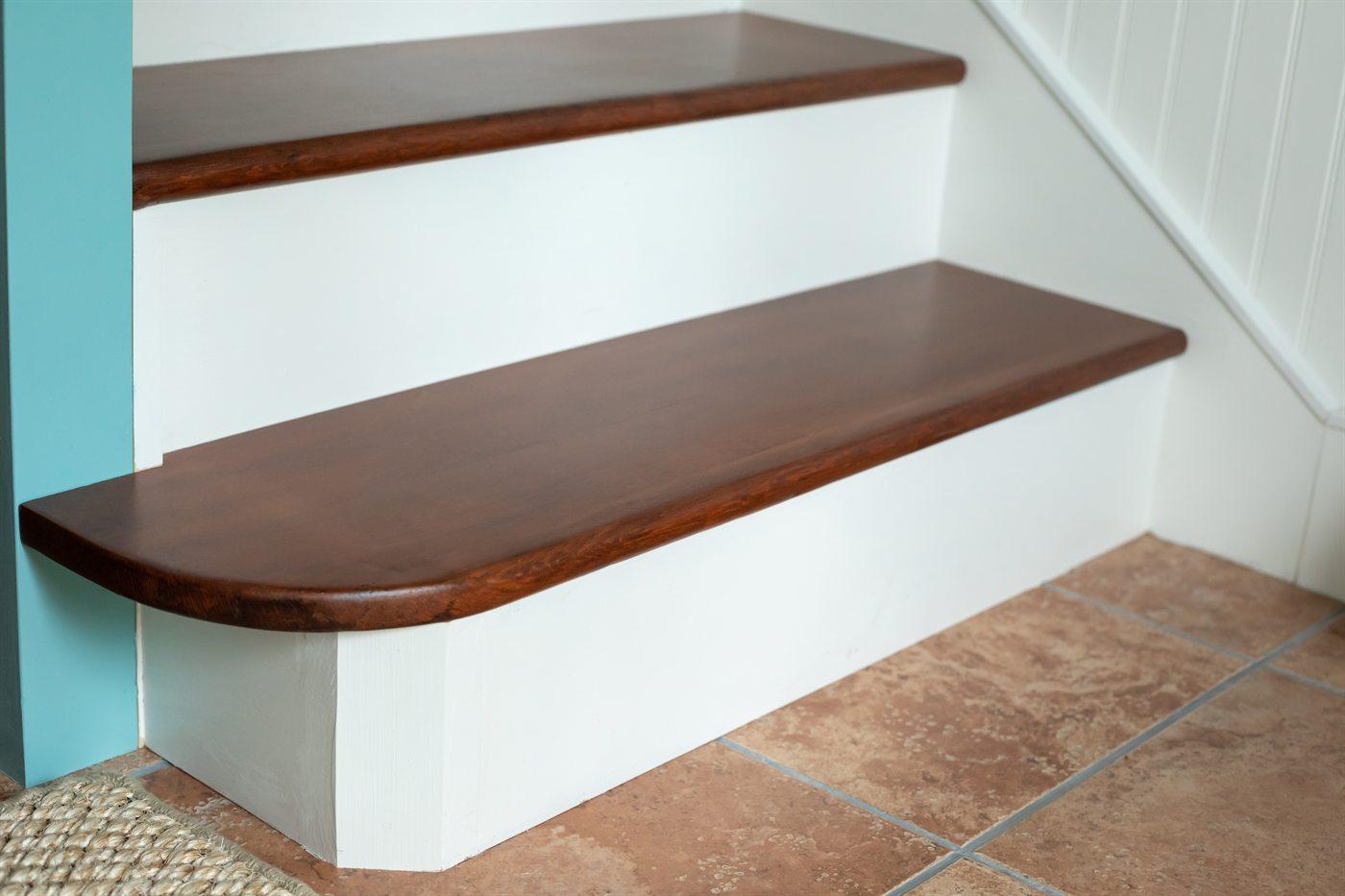
The 8070 is a full-thickness 1″ solid hardwood tread that replaces an existing tread or installs on a new-build stringer. The 8071 is a 5/8″ overlay with a built-up 1″ bullnose that caps an existing tread without demolition. Pick by stair condition and what happens at the top and bottom of the flight — not by price alone.
Pick the 8070 if the existing tread is gone or has to come up.
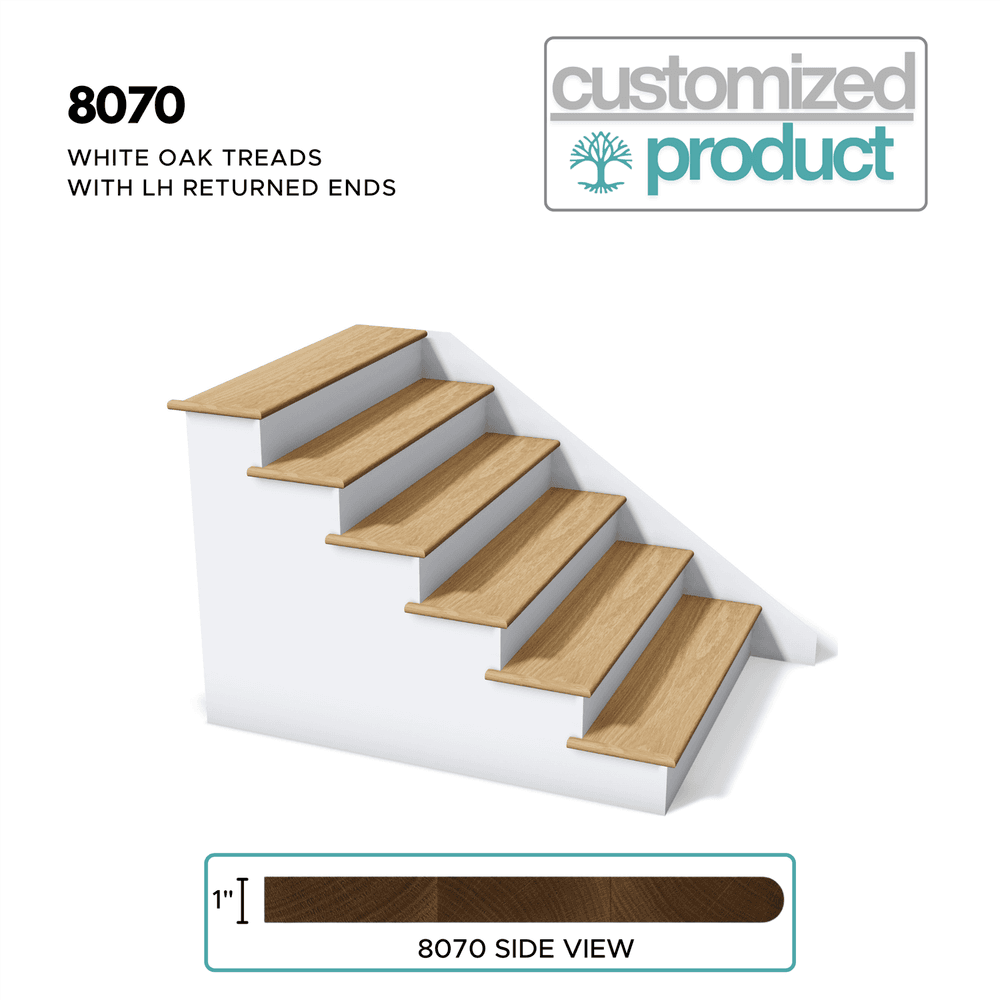
The 8070 is the standard new-build / full-replacement stair tread. Full-thickness, full-bullnose, edge-glued solid hardwood — it drops onto a clean stringer at the correct rise once the old tread is out (or there was never a tread to begin with). If the existing tread is loose, squeaky, structurally compromised, or you are building new: 8070.
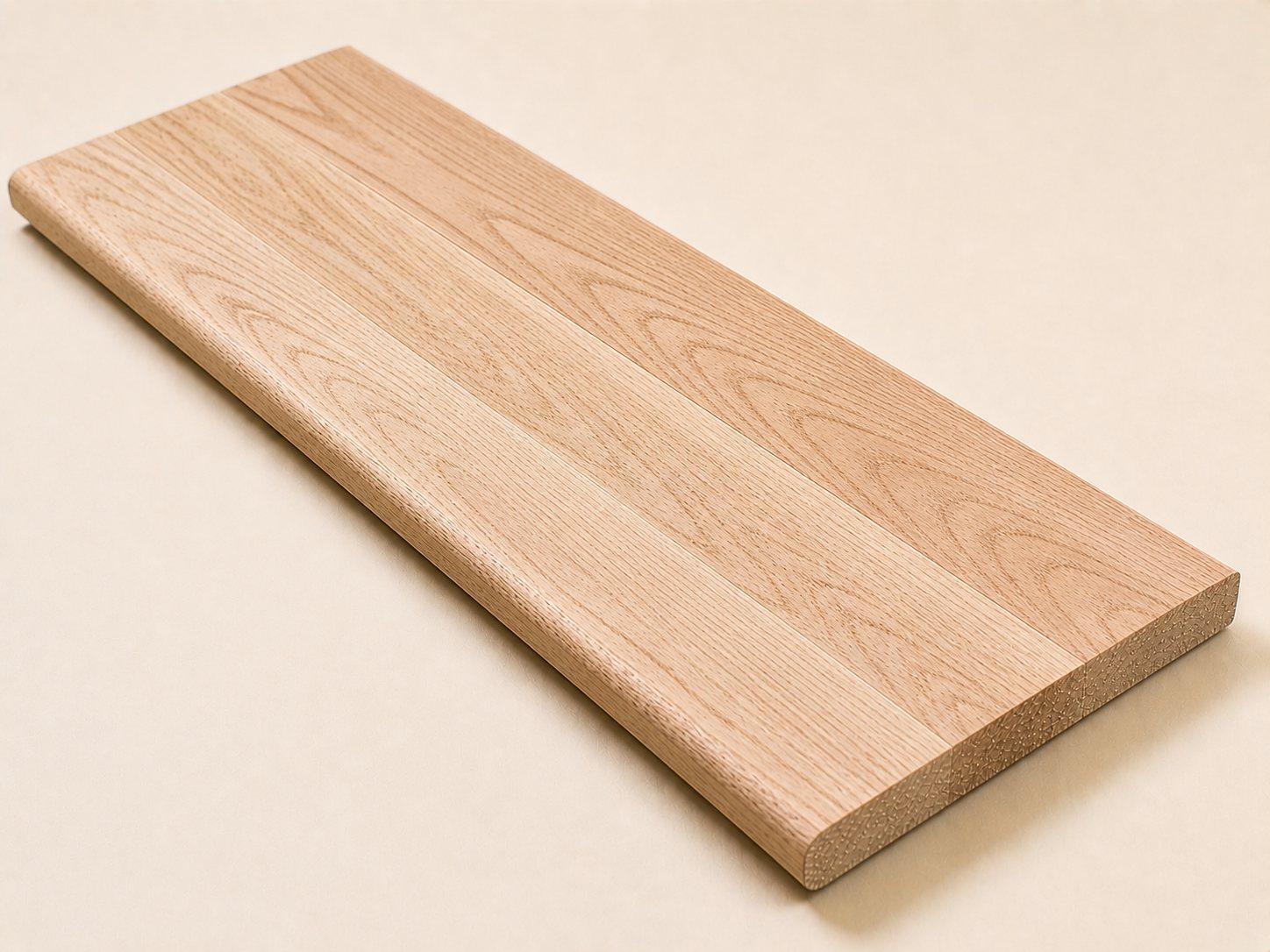
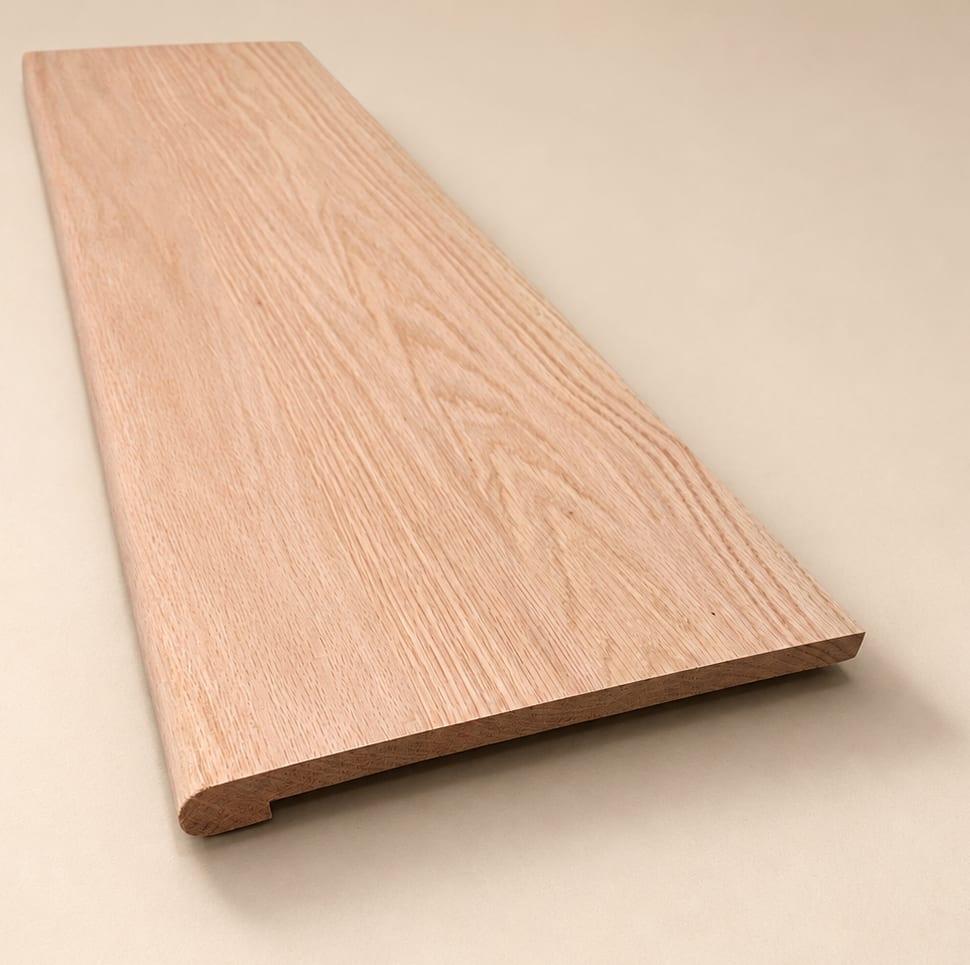
The 8071 is the renovation overlay. A 5/8″ body with a built-up 1″ bullnose, designed to lay on top of an existing tread — so the stringer never gets opened up and the labor stays in the trim-carpenter zone instead of the carpenter-plus-stair-builder zone. If the existing tread is sound and both ends of the flight can absorb a 5/8″ change: 8071.
Side-by-side, on the same sheet.
| Attribute | 8070 — Full Bullnose | 8071 — Retro-Fit Overlay |
|---|---|---|
| Body thickness | 1″ solid hardwood | 5/8″ solid hardwood |
| Nose profile | Full 1″ bullnose milled into the body | Built-up 1″ bullnose laminated to the front edge |
| Depth | 11-1/2″ | 11-1/2″ |
| Where it sits | Direct on the stringer | On top of the existing tread |
| Prep required | Remove the old tread, level the stringer, check for squeaks | Strip to bare wood, cut the old nosing flush with the riser, scuff the surface |
| Effect on the flight | None — replaces an equal-thickness tread | Every tread rises 5/8″: first rise grows 5/8″, last rise shrinks 5/8″ unless the landing and lower floor are reconciled (see below) |
| Labor per step (typical) | 45–75 minutes | 20–35 minutes |
| Species in the catalog | Red Oak, White Oak | Red Oak, White Oak |
| Catalog lengths | 42″, 48″, 60″ · Red Oak also 72″, 84″, 96″ | 42″, 48″ |
| Returned-end option | Yes — reversible returned end at 48″ and 60″ | Custom run only |
| Matching landing | 8070 platform landing | None for the 8071 — the 8073 square-edge retro-fit has a 48″ × 48″ landing |

Three jobs the 8071 was built for.
The retro-fit overlay shines on the renovation jobs that do not want the disruption (and the cost) of a full stair rebuild. Three patterns we see week after week at Tanner Rd:
- Carpet-to-wood conversion where the existing tread under the carpet is plywood or particleboard in sound shape. Strip the carpet, pad and tack strip; cut the old nosing flush; scuff the substrate; glue and nail the 8071 over the top. The whole stair finishes in a long day — and the new 3/4″ hardwood going down on the floors at the same time usually reconciles the bottom rise on its own.
- Worn finish on existing hardwood treads where the bullnose is chipped or rounded off and a sand-and-refinish will not recover it. Cut the old nose off and the 8071 puts a new bullnose on, in matching or contrasting species.
- Homes where the upper-floor finished height is not locked — landings, lofts and second floors that can take a matching 5/8″ overlay without breaking thresholds, jambs or shoe.
When retro-fit won't cut it.
Four conditions push the job out of retro-fit territory and into a full 8070 tread replacement (or a new-build install):
- Loose, squeaky, or split treads. An overlay on a bad tread just hides the problem — and the squeak transmits straight through the new wood. Pull the old tread, fix the riser/stringer joint, install 8070.
- Upper landing height is locked. If the second-floor hardwood, tile or LVT is already in and cannot come up 5/8″, the top rise ends up 5/8″ short — past the IRC 3/8″ limit. Most of those jobs go to 8070 instead.
- Custom-stained or oil-rubbed finish where the homeowner wants every tread fully consistent in grain. Edge-glued solid 8070 reads cleaner than a 5/8″ body with a separate nose-strip glue line — the seam is visible on close inspection.
- New construction. There is no existing tread to overlay. The carpenter sets risers and stringer, drops in 8070 treads, calls it.
The price difference is in the carpenter, not the SKU.
Per-tread material cost between the 8070 and 8071 is close — the 8071 uses slightly less hardwood, but the built-up nose adds a glue-up step in production. The real cost gap is labor:
- A 13-step staircase replaced with 8070 treads is typically a 1.5–2 day job: tear-out, debris removal, level and scribe each step, install. The stairs are out of service for that time.
- The same 13-step staircase covered with 8071 retro-fit treads is a one-day job for an experienced trim carpenter, plus half a day of prep on a carpet conversion. Stair-restricted access while the glue sets.
- Houston trim-carpentry rates run roughly $65–$95 an hour, with stair-builder rates higher for full replacement. Across 13 steps, the labor delta runs $800–$1,800 in the retro-fit's favor.
For a quote on the actual material cost on your job, run the configurator below — it picks the right SKU from your inputs and returns a planning estimate.
Quick answers.
- Can I overlay only one or two squeaky steps with 8071 and leave the rest alone?
- No. The 8071 raises the steps you overlay by 5/8″. Raising only some of them breaks the IRC rise-uniformity rule (max 3/8″ variation between the biggest and smallest rise in a flight). Either overlay the whole flight or fix the squeak by replacing those treads with 8070.
- Will the 8071 retro-fit overlay change my tread depth (run)?
- Not if the old nosing is cut flush with the riser first, which is the standard prep. The riser faces do not move, so the nosing-to-nosing depth stays what it was and the new bullnose projects 1-1/4″ — inside the IRC 3/4″–1-1/4″ range. Hanging the new nose in front of the old one instead pushes the projection past 1-1/4″.
- Do I need to remove my carpet before installing 8071 retro-fit treads?
- Yes. The 8071 is designed to lay on the original wood tread, not on padding. Strip the carpet, pad and tack strip; scrape any old adhesive; cut the old nosing flush; sand or scuff the wood; then glue and nail the 8071 over the top.
- Which species should I match to my existing floor?
- Red Oak under most older stained finishes; White Oak under modern wire-brushed, fumed, or rift-and-quartered floors. Both are in the catalog for the 8070 and the 8071 — bring a piece of the floor to the Tanner Rd counter if you are unsure.
- Does UWP install these treads?
- UWP does not install — we are a Houston millwork supplier. We supply solid hardwood treads and provide on-site precision templating for curved stairs ($125–$175 per tread) so your installer has accurate templates. For installation, we can refer trim carpenters and stair contractors who buy from us regularly.
Spec your tread or read the install guide.
8070 Bullnose Stair Tread
Solid 1″ full-replacement tread, Red Oak and White Oak.
View →Product8071 Retro-Fit Stair Tread
5/8″ overlay with built-up bullnose. Renovation install.
View →Field GuideRetro-Fit Tread Guide
Five field checks, the 3/8″ rule drawn out, and the install sequence.
View →Install GuideStair Tread & Riser Installation Guide
Full install steps as a page, with the PDF download.
View →Questions next to this one
8070 vs. 8071 — which stair tread fits my existing staircase?
The 8070 is a full 1″ tread for new builds or full demos. The 8071 is a 5/8″ retro-fit overlay built to drop over carpeted stairs without demolition. The key reason: when you pull the carpet, the wood skirt board next to the staircase is roughly 11/16″ thick. The 8071 lands flush against it. The 8070 sits about 1/4″ proud and looks unfinished.
Read the answer →What’s the difference between a 1″ and a 1¾″ stair tread?
A 1″ stair tread is a retrofit cap that drops over an existing staircase — fast, affordable, and the right choice for most closed-stringer residential stairs. A 1¾″ thick tread is a structural-looking slab built for open, floating, or modern stairs where the tread itself is part of the architecture. Thickness changes the price, the install, and the entire look of the stair — not just the dimension.
Read the answer →Can you retrofit thick stair treads over existing stairs?
Thick stair treads (1¾″ to 3½″) aren’t retrofit material — adding that much thickness changes the rise of the top step, puts the stair out of code, and creates a visible step where the new tread meets the upstairs floor. For the thick-tread look on existing stairs, the honest answer is a full tear-down to the stringers and a rebuild from the framing up.
Read the answer →What are the standard dimensions of a hardwood stair tread?
A standard hardwood stair tread is 1 inch thick, 10-1/2″ to 11-1/2″ deep (front to back), and stocked in 42″, 48″, and 60″ widths at UWP — with red oak running to 96″. The IRC building code requires a minimum 10″ tread depth with a 3/4″ nosing overhang. Custom widths, depths, and thicknesses are available built to order.
Read the answer →
Terms used in this guide
Build a planning estimate — we mill in Houston.
Pick species, thickness, nosing, length and finish. The configurator returns a planning estimate; Tanner Rd confirms material and timing on the written quote.