

Spec drawing
UW-M674SB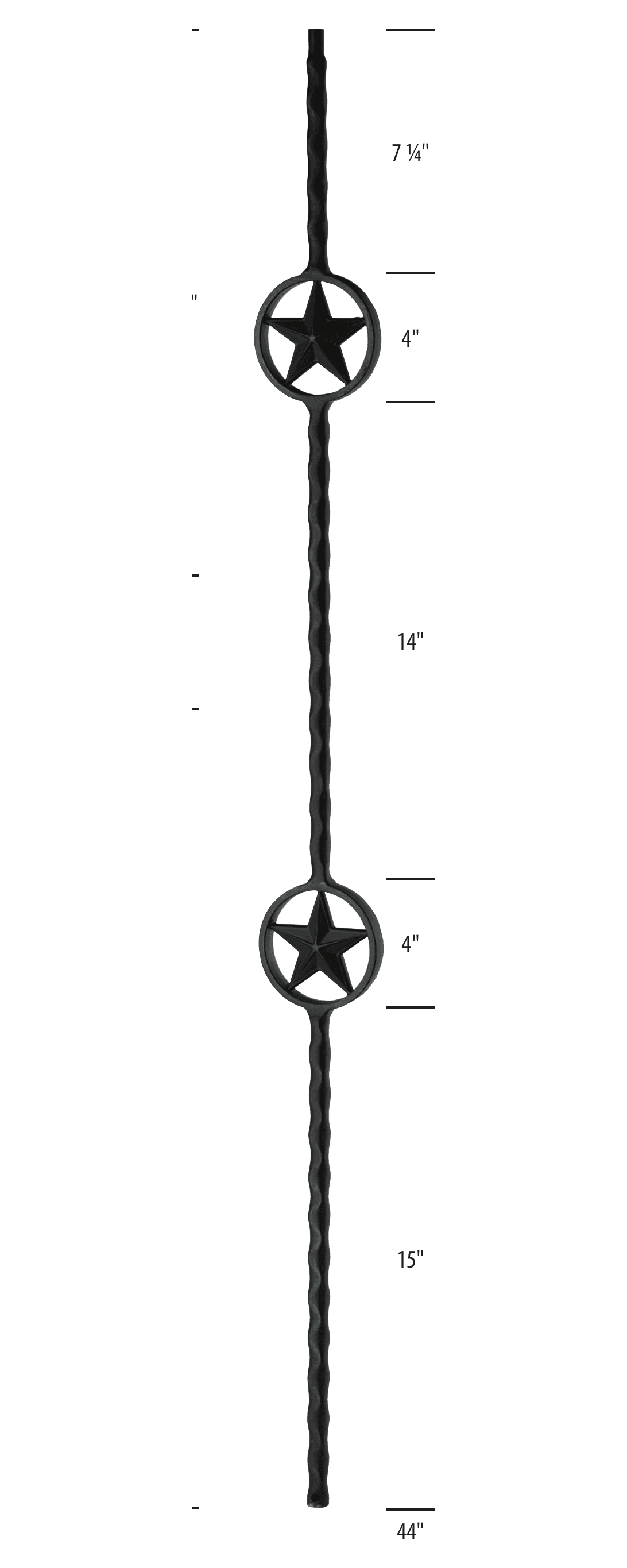
M674 — Two cast 4" star medallions in pierced rings · 1/2" Sq × 44"
Iron Balusters · 1/2" Square
UW-M674SBDouble Star Iron Baluster
Order # 1035551
- Satin Black
Satin Black keeps the silhouette sharp against painted trim, stained treads, and white risers. It is the safest finish when the baluster shape needs to read clearly from the entry.
- Order #1035551
- FinishSatin Black
- End shape1/2" Square
- Length44"
- Lead timeConfirmed at quote
A 1/2" square iron baluster with two stacked Texas-star medallions, built for projects that need a stronger decorative read than the single-star version. The two rings create a taller focal band through the center of the rail, so the part carries more visual weight. Use it sparingly at entry stairs, mid-run features, stair corners, or landings where a single star feels under-scaled. Satin Black keeps the motif crisp and readable against painted trim and stained treads.
Everything on one card
- FinishSatin Black (SB)
- MaterialHammered iron
- End shape1/2" square top & bottom
- Length44"
- Center detailTwo cast 4" star medallions in pierced rings
- MountingEpoxy-set (UW-EPOXY)
- Pairs with1/2" Sq flat shoe, rake shoe
- UseInterior wood-stair balustrade
- Lead timeConfirmed at quote
- Minimum order1 piece
- WarrantySee Stair Parts warranty
Order these together
A baluster doesn't install alone. Most jobs need the epoxy plus the matching shoes for the flat run, rake, and top.
- UW-EPOXY
Baluster Epoxy
Sets the baluster into the tread and handrail mortise. One bottle sets approximately 30 balusters.
View part → - UW-ALM06-LSB
1/2" Square Flat Shoe — Low Sheen Black
Goes at the bottom of each baluster on level runs (landings, level rails).
View part → - UW-ALPSH02-LSB
1/2" Square Rake Shoe — Low Sheen Black
Goes at the bottom of each baluster on the rake (stair angle).
View part → - UW-M798SB
1/2" Square Adjustable Knuckle — Satin Black
Sits at the top of each baluster where it meets the underside of the handrail; adjusts to the rake.
View part →
The double-star feature
for entries, landings, and stronger Texas-themed runs.
The Double Star is not a quiet field baluster. Treat it as a feature part where the rail needs a vertical focal point and enough stair width to absorb the ornament.
Entry stair feature
Two stacked stars hold attention at the first visible section of the staircase, especially beside a larger starting newel.
Mid-run marker
Use one or two pieces to mark a long rake run without repeating star details on every opening.
Landing corners
The taller decorative band works well at turns, balcony corners, and visual stopping points.
Ranch lodge interiors
Best with heavier wood tones, hammered metal notes, and rustic architectural finishes where the star language already belongs.
Answers, before you ask
- What size is this baluster?
- This shape is 1/2" square and 44 inches overall before jobsite trimming. Confirm finished rail height, tread depth, and local guard requirements before cutting.
- Which finish should I order?
- This shape ships in Satin Black only. For other finishes (Antique Bronze, Oil Rubbed Bronze, Oil Rubbed Copper, Silver Vein) see the M-series plain, twist, and scroll balusters — those families run the full finish set.
- Should the double star repeat through the whole run?
- Usually no. The two-star stack has enough visual weight to act as a feature baluster. Pair it with plain square bars or simpler star pieces so the staircase does not turn into a fence pattern.
- How is it installed?
- Most iron balusters are trimmed to length and epoxy-set into the tread and rail. Shoes can be added at the bottom and top to cover the mortise or drilled opening.
- What is the lead time?
- Current material availability, production timing, pickup, and delivery are confirmed on the written quote after UWP reviews the exact SKU, species, quantity, geometry, and shop capacity.
- Do you show pricing here?
- Not on this reference page yet. The builder/trade pricing tier is in development — when it ships, pricing will appear after login. For an immediate quote, call the Tanner Rd yard at (713) 462-5045 or use the Quote List to send a project quote request.
Questions people ask about iron balusters
Iron vs. wood balusters — which one for my staircase?
Wood balusters read as traditional and warm; iron balusters read as transitional, modern, or industrial. Wood is easier to install, refinishable, and matches stained handrails. Iron is more durable, allows thinner profiles for a more open stair, and pairs well with mixed-material designs. Most Houston homes built since 2010 use iron; older traditional homes use wood. Mix them only if the design language supports it.
Read the answer →What are the IRC stair code rules in plain English?
The IRC residential stair code requires a minimum 10″ tread depth, a maximum 7-3/4″ riser height, a 3/4″ nosing overhang, 36″ minimum stair width, 6′8″ minimum headroom, and handrails on at least one side. Variation between any two treads on the same flight cannot exceed 3/8″. Most code violations on retrofit jobs come from changing the tread thickness without re-framing the stair.
Read the answer →How do I choose a stair newel post?
A newel post is the structural anchor at the top, bottom, and turns of a stair railing. The four main families are box newel (large rectangular, traditional), turned newel (classical with profile turning), modern square (clean tapered or straight), and craftsman (substantial square with shaker detail). Size to the stair scale (4 to 8 inches), match the baluster style, and use the same wood species as the handrail.
Read the answer →Stair terminology glossary — tread, riser, stringer, nosing, and the rest
A staircase has more named parts than most people realize. The tread is the horizontal walking surface; the riser is the vertical board between treads; the stringer is the diagonal structural framing; the nosing is the front lip of the tread; the skirt board is the trim against the wall. Below: every term, plain English, with a note on where each one matters for ordering and installation.
Read the answer →