

Mapei Mapecem Quickpatch
High-Performance Concrete PatchFast-Set · Interior & Exterior
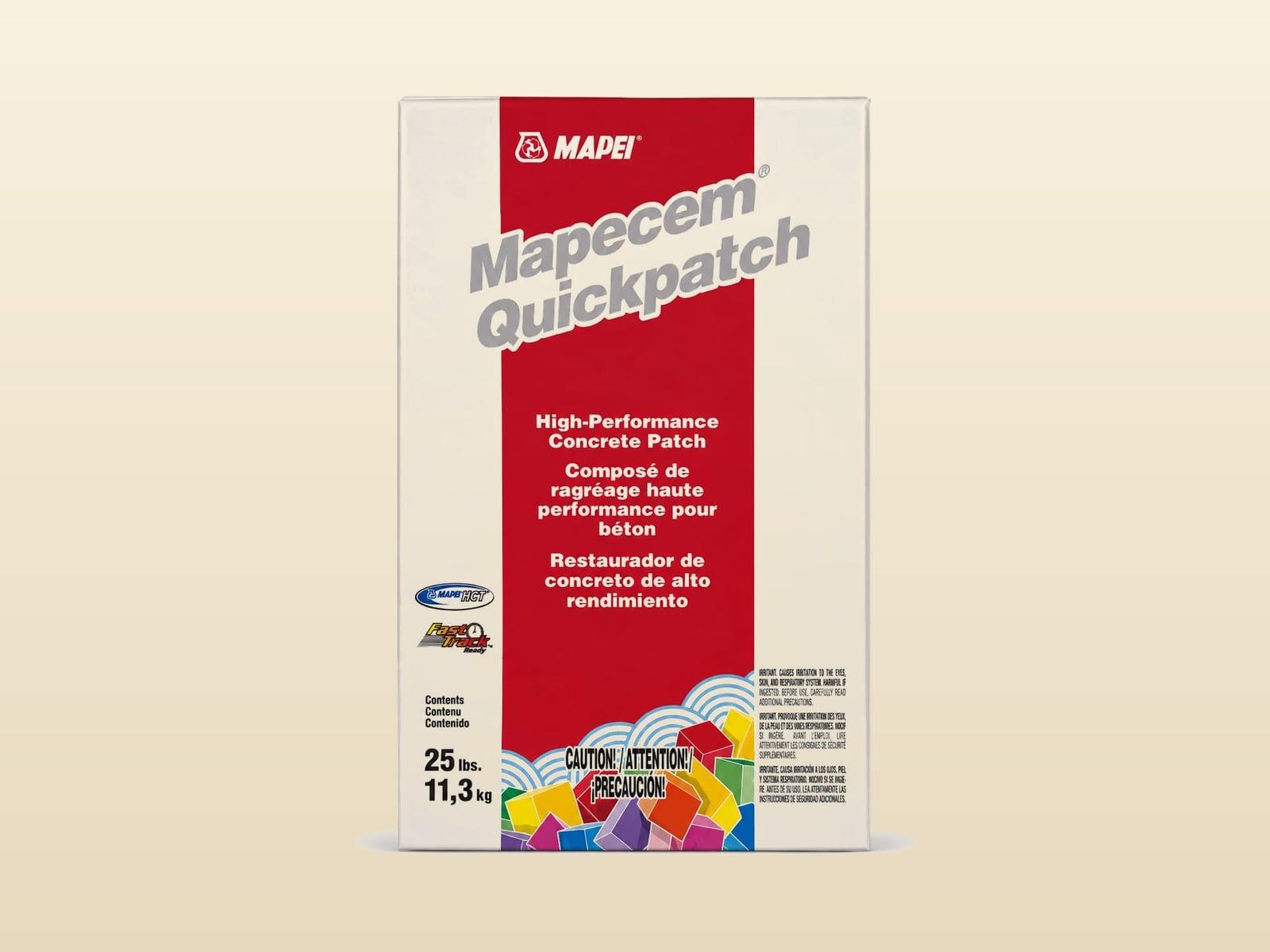
Fix the slab. Drive on it the same day.
Mapecem Quickpatch is Mapei's fast-setting, polymer-modified, cement-based mortar for repairing interior and exterior concrete surfaces. Patches ¼″ up to 2″ in a single lift, opens to foot traffic in ~1 hour and vehicular traffic in ~4 hours, and pulls more than 5,500 psi at 28 days. Use it on spalled slabs, broken edges, ramps, steps, parking decks, and garage floors — 25 lb bags stocked at NW Houston / Tanner Rd.
- ·¼″ to 2″ per lift
- ·Foot traffic in ~1 hour
- ·Vehicular in ~4 hours
- ·> 5,500 psi at 28 days
Built for concrete that can't wait.
Sets in roughly 15 minutes at 73 °F. Open to light foot traffic in about an hour, vehicular traffic in about four — the right call when a slab repair has to come back online same day.
Patches spalled concrete, broken edges, joints, and depressions from ¼″ up to 2″ thick in one pull. Non-shrinking, no rebound, no telegraph through the finished surface.
Polymer-modified, cement-based, freeze/thaw stable. Use on slabs, sidewalks, ramps, loading docks, parking decks, steps, and garage floors — interior and exterior both.
Technical data.
Specifications per Mapei's current Mapecem Quickpatch technical data sheet. Tolerances are nominal and subject to manufacturing variance. Always refer to the current Mapei TDS and SDS before installation.
What it goes over.
- ·Cured concrete (slab-on-grade and suspended)
- ·Spalled or scaled concrete surfaces
- ·Concrete steps, edges, and corners
- ·Sidewalks, ramps, and loading docks
- ·Garage floors and parking decks
- ·Structurally sound masonry
What it fixes.
- ·Spalled concrete repair
- ·Broken edges, joints, and corners
- ·Floor leveling for subsequent flooring install
- ·Sidewalk, ramp, and step repair
- ·Garage and warehouse slab patching
- ·Parking deck and loading-dock fills
Substrate must be structurally sound, clean, and free of dust, oils, curing compounds, sealers, paint, or any contaminant that could break the bond. Saw-cut repair edges square — never feather. Pre-dampen the substrate to a saturated surface-dry (SSD) condition before placement. Mix and place per the current Mapecem Quickpatch TDS; pot life is short, so batch what you can place in 5–10 minutes.
Mapecem Quickpatch by the 25 lb bag — pulled at the Tanner Rd yard.
Questions people ask about the floor going over this
How do I install SPC flooring?
SPC installs as a click-lock floating floor over almost any substrate. The sequence: confirm the subfloor is flat (within 3/16″ over 10 feet), acclimate the planks 48 hours, lay an underlayment if needed, click planks together starting at the longest wall, leave a 1/4″ expansion gap at every wall and obstruction, finish with baseboard or quarter round. Most rooms install in a weekend.
Read the answer →Click-lock vs. glue-down flooring — which installation method should I choose?
Click-lock floats over the subfloor with no adhesive — fast to install, easy to remove for repair, but slightly hollow underfoot. Glue-down bonds the floor directly to the subfloor — feels more solid, transmits less sound, lasts longer, but is far harder to repair or replace and requires a perfect substrate. Pick click-lock for fast residential installs; glue-down for commercial and premium residential.
Read the answer →Can I use wood flooring over radiant heat?
Yes, wood flooring works over radiant heat — but with specific rules. Engineered hardwood is strongly preferred over solid; narrower planks (5″ or less) are safer than wide planks; quarter-sawn cuts move less than plain-sawn; floor temperature must stay under 80°F at the wood surface. Install with proper acclimation and a slow heat ramp-up. Solid hardwood is possible but requires careful species selection and width discipline.
Read the answer →How do I acclimate hardwood before installing it?
Acclimate hardwood by stacking the material in the install space — not the garage, not the porch — for 5 to 7 days before installation. The room must be HVAC-conditioned at typical living temperature and humidity. The wood reaches equilibrium moisture content with the room and will not move significantly after install. Skipping this step is the #1 cause of post-install gaps, cupping, and squeaks.
Read the answer →